Publications autour du thème de l'Agriculture en Permaculture
Autres sites web avec des publications intéressantes
Notre collection de publications et de travaux de recherche
124 Publikationen gefunden
Thesis
octobre 2025
Charles University
Linda Blättler
This thesis explores the sustainability potential of permaculture, a socio-ecological movement that seeks to ecologise agriculture and generate benefits across ecological, economic, and social dimensions. The research applies an integrated methodological framework grounded in the concepts of ecosystem services and nature’s contributions to people. Using a multidisciplinary mixed-methods design, the study assesses material, reg-ulating, and non-material contributions across eight permaculture farms—six located in Czechia and two in Belgium.
Regulating services were evaluated through quantitative biophysical field meas-urements, material services through a combination of ecological and social science ap-proaches, and non-material services through qualitative inquiry. This holistic design al-lowed for the integration of ecological data with social science perspectives, offering a comprehensive assessment of permaculture’s contributions to multifunctionality, resili-ence, and sustainability.
Results show that permaculture spans all domains of ecosystem benefits, but its particular strength lies in mobilising relational values that encourage biodiversity-support-ing practices, which in turn underpin regulating services. Permaculture demonstrates high capacity to provide regulating services and can contribute valuable insights for sustainable food futures. A slightly lower delivery of material services may inform a debate about land sharing versus land sparing in agriculture and about diet change in exchange for nutrients diversity, leading to sustainable solutions based on broad values of respect, health and prosperity.
Artikel
octobre 2025
Trier University of Applied Sciences
Pabst, Holger; Lang, Johannes; Schmidt, Marie Sophie
The current policy framework for agroforestry is insufficient for widespread practical adoption. Although agroforestry is increasingly included in policies and funding strategies, it remains unclear whether this support is enough to implement systems effectively or compensate farmers for the public benefits they provide. Additionally, land use and water management policies are often disconnected and lack transparency, leading to conflicting goals and incoherent instruments. It is uncertain whether new legal frameworks will improve policy coherence or provide better support.
This Deliverable 7.1 outlines key political and regulatory elements at the European level and then examines the agroforestry–water relationship in the AFaktive project regions: Rhineland-Palatinate and Saxony-Anhalt (Germany), Flanders and Wallonia (Belgium), and the Netherlands. Each regional chapter discusses projected climate change impacts, current agroforestry status, and water body conditions. It reviews national and regional legislation, focusing on how agriculture and water management are addressed together and whether synergies are being used. The report also explores how agroforestry is considered in agricultural policy and the Water Framework Directive, and evaluates the roles of authorities, NGOs, and research institutions. Finally, it discusses challenges and opportunities for better aligning agroforestry with water management both within the project and beyond.
Artikel
août 2025
Anja Chalmin
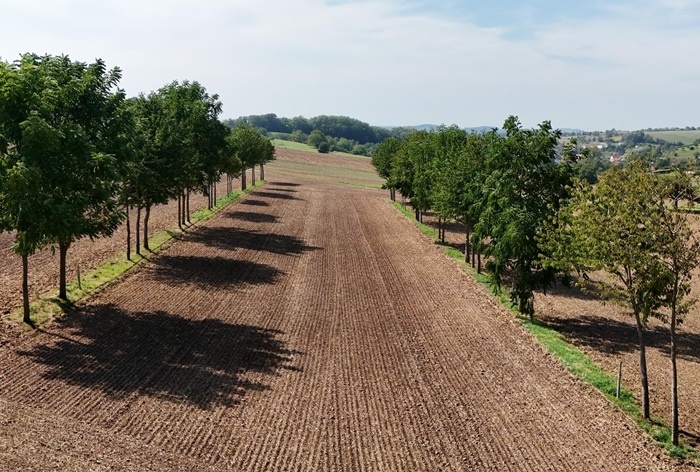
Agroforstsysteme sind landwirtschaftliche Anbausysteme, die Gehölze mit landwirtschaftlicher Nutzung kombinieren. Sie bieten zahlreiche ökologische, ökonomische und soziale Vorteile (Nair 1993). So können Agroforstsysteme die Biodiversität fördern, die Bodenfruchtbarkeit verbessern, vor Bodenerosion schützen, zur Kohlenstoffbindung beitragen, die Wasseraufnahme des Bodens erhöhen und das Mikroklima positiv beeinflussen (DeFAF 2025). Darüber hinaus ermöglichen Agroforstsysteme Landwirt:innen eine Diversifizierung ihres Einkommens, was die wirtschaftliche Stabilität landwirtschaftlicher Betriebe erhöhen kann. Agroforstsysteme gewinnen zunehmend an Bedeutung für eine nachhaltige Landbewirtschaftung. Bislang liegen jedoch nur wenige kalkulatorische Daten zu Erträgen und Erntetechnik der Gehölzkomponente in Agroforstsystemen vor. Ziel des Projekts war es daher,
(1) die Produktionsziele der Gehölzkomponente in Agroforstsystemen zu systematisieren;
(2) Erträge, Qualitäten, Ernteintervalle und Preise zu erfassen;
(3) die Technik und Mechanisierungsmöglichkeiten für die Ernte zu beschreiben, Arbeitsablaufbeschreibungen zu erstellen, Arbeitserledigungskosten zu berechnen und die Erntezeitfenster in Relation zu den ackerbaulichen Hauptkulturen zu beschreiben.
Im ersten Teil des Projekts wurden die ersten beiden Ziele bearbeitet.
Artikel
août 2025
Caroline Grindrod
Regenerative agriculture stands at a critical juncture. While corporate investment has reached unprecedented levels—with companies like Nestlé committing $1.3 billion over five years and Cargill targeting 10 million acres—the outcomes depend entirely on how regenerative agriculture is understood and implemented. This white paper provides evidence-based analysis demonstrating that the benefits and pitfalls of regenerative agriculture are determined by the level of implementation and understanding of its diverse approaches.
Artikel
juillet 2025
Climate Smart Agriculture, 2, (2), 2025, Artikel 100055.
Agroscope, ZHAW
Roberti G., Herzog F., Jäger M., Kay S.
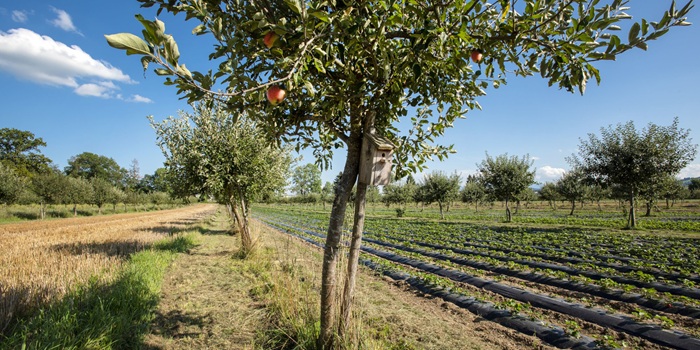
Agroforestry, the integration of woody structures in agricultural land, has high potential for climate protection and resilience, since trees are active carbon sinks. Yet, there is only limited empirical evidence on the actual performance of temperate agroforestry systems in this respect, nor on its acceptance by farmers. We monitored four silvoarable agroforestry systems in Switzerland (apple, sour cherry, poplar, wild cherry) over ten years and measured tree growth and carbon storage performances. We compared the measured data to outcomes of the Yield-SAFE model. We regularly interviewed farmers on their observations of their agroforestry systems. Individual growth of agroforestry trees varied between species and location, with differences between the smallest and largest tree ranging from 44 % to 97 %. Consequently, the carbon sequestration potential varied substantially between 0.4 and 2.5 t CO2eq per year and hectare. The modelling approach showed a good fit for apples and wild cherries and – after (re)calibration with local data – also for poplars and sour cherries. Tree mortality was up to 20 % in the first years but if replaced, this did not influence the overall outcome after ten years. Farmers‘ evaluations differed, depending on the motivation of individual farmers. They changed only slightly with time, indicating that their expectations had been realistic. The study highlights the usefulness of long-term empirical
data for model calibration and of monitoring farmers‘ satisfaction. Realistic model predictions and management of
farmers‘ expectations will facilitate the implementation of agroforestry.
Bachelorarbeit
juin 2025
Hochschule Weihenstephan-Triesdorf
Johannes Knoll
Auf einem gut 1.100 m² umfassenden Hühnerauslauf von Irene und Sepp Braun soll ein solcher Waldgarten entstehen, mit welchem das Paar den alltäglichen Bedarf zukünftig teilweise abdecken und sich selbst versorgen möchte. Mit dieser Idee für eine Bachelorarbeit ist die Familie an die Hochschule Weihenstephan-Triesdorf herangetreten. In Abstimmung mit den Flächenbesitzern und Betreuern wurde das Thema dahingehend festgelegt, dass die geplante Pflanzung begleitet und finanziell bewertet werden sollte. Eine genauere Beschreibung der Beweggründe für die Anlage einer solchen Kultur folgt in Kapitel 4.1.1.
Die vorliegende Bachelorarbeit setzt sich zum Ziel, eine Einwertung der Investitionskosten in die Baum- und Strauchschicht sowie die Vorbereitungen und Pflegekosten eines Waldgartens zu treffen und diese anhand der erwarteten Erträge mit den monetären Einsparungen auf Seiten des alltäglichen Nahrungsbedarfs gegenzurechnen. Somit soll eine Grundlage für Landbewirtschafter und Grundbesitzer geschaffen werden, an welcher sich diese orientieren können, ob eine solche Form der Permakultur aus ökonomischer Sicht eine Option für die eigene Situation darstellt. Dieses Vorhaben soll mit den drei nachfolgend genannten Fragestellungen beantwortet werden:
I. Worauf wurde bei der Planung der Fläche geachtet und welche Überlegungen liegen derer zugrunde? Hierbei sollen sowohl die Wünsche und Vorgaben der Flächenbesitzer bei der Planung betrachtet werden als auch die Überlegungen des Planers.
II. In welchem Umfang kann die geplante Pflanzung den Nahrungsbedarf zweier Personen abdecken?
Diese Frage zielt auf das Potential der gegebenen Fläche ab und befasst sich damit, wie viel die geplanten Pflanzen zur Deckung des Nahrungsbedarfs von zwei erwachsenen Menschen beitragen können. Damit soll eine Basis geschaffen werden, mit welcher der ökonomische Nutzen dieses Waldgartens erhoben werden kann.
III. Wie viel kostet die Etablierung eines Waldgartens und ab wann ist mit einem Return on Investment (ROI) zu rechnen?
Es soll aufgezeigt werden, ab wann sich die Investition in die Anlage eines Waldgartens rechnet sowie eine Einschätzung der jahresweisen Rentabilität. Eingangsgrößen hierfür sind die Kosten für Arbeit und Material sowie die Ergebnisse aus Frage II und Berechnungen zu Marktpreisen für entsprechende Fruchtmengen.
Artikel
juin 2025
Agroforest Syst 99, 130 (2025)
Gosme, M., Staněk, T., Rigal, C., Paut, R., Skyum, B., Rønn-Anderson, K., Thissen, W., den Herder, M., Houska, J., Lojka, B., Warlop, F., Carton, S., Pardon, P., Weger, J., Martiník, A., Uradnicek, L., Hübner, R., Tomás, A., Kay, S. & Reubens, B.
Selecting the right tree species is a crucial step in designing sustainable and effective agroforestry systems. To support this process, several decision support systems (DSS) have been developed in various countries to help farmers and advisors choose appropriate species. However, these tools are often limited in reach—typically used only within the country where they were created—and tend to focus on different aspects of adaptation to local conditions or achieving specific farming objectives. In this context, we introduce a new framework for agroforestry tree species selection. Its goals are twofold: (i) to compile and organize the knowledge embedded in existing tree selection tools, and (ii) to offer an intuitive, user-friendly graphical interface—AgroforesTreeAdvice. This tool allows users to input local parameters such as soil type, climate, biotic factors, and farm-level or socio-economic constraints, alongside production goals (e.g., timber, fruits) and ecosystem service objectives (e.g., soil conservation, carbon storage). The unified system successfully integrates eight existing agroforestry DSS, improving their (i) findability by centralizing them in one location, (ii) accessibility through a standardized and user-friendly interface, (iii) interoperability by enabling API-based queries across all tools, and (iv) reusability for future DSS development. Finally, we present early user feedback from pilot deployments in three countries, highlighting the tool’s benefits and outlining next steps toward further harmonization of agroforestry databases.
Artikel
mai 2025
Agronomy for Sustainable Development
Universität Hohenheim
Olef Koch, Jennifer Moore, Jakob Hörl, Michael Cormann, Sebastian Gayler, Iris Lewandowski, Sven Marhan, Sebastian Munz, Markus Pflugfelder, Hans-Peter Piepho, Julia Schneider, Moritz von Cossel, Tanja Weinand, Bastian Winkler & Andreas H. Schweiger
As warm season droughts increase in frequency due to climate change, causing severe yield losses especially among cereal crops, European agriculture is in dire need of adaptation. While agroforestry is widely regarded as a key adaptation measure, little is known on how yield performance is influenced by changing water availability in temperate regions. Therefore, we assessed the yield dynamics of five winter crops (winter wheat, triticale, winter barley, winter pea, and rapeseed) during seven growing seasons (2012 to 2023) in a well-established (since 2007) alley cropping agroforestry trial site in Southwestern Germany. The trial integrated three different agroforestry practices in a randomized block design: (i) willow short-rotation coppice, (ii) walnut trees for nut production, and (iii) diverse hedgerows. The relationship between crop yield and climatic water balance was analyzed using a linear mixed-model. In this unique long-term comparison, we demonstrate that individual alley cropping practices exhibited distinct yield patterns with increased distance to tree rows. In contrast to the willow short rotation coppice, walnut and hedgerows did not evoke significant winter crop yield declines at proximity. While in the walnut plots yields did not significantly vary with distance to tree rows, yields adjacent to hedge rows declined significantly towards the alley center. Moreover, tree rows contributed to stable crop yields under fluctuating water availability in their proximity and up to the alley center on their leeward side while yields significantly varied with changing climatic water balance on the windward side. Our results underline the potential of agroforestry to sustain yields in the face of increasingly variable water availability, further substantiating the contribution of alley cropping agroforestry for farming systems’ resilience to increasingly variable weather conditions. They moreover contribute to planning and policy support for advancing agroforestry as a climate smart solution in temperate regions.
Masterarbeit
mai 2025
Lund University International
Tine Louise Aarup
In Denmark food production is dominantly influenced by industrial agriculture, which has been increasingly scrutinized for its negative environmental impacts making it evident that alternative food systems must be explored. This could, for example, be permaculture which guides people to live in harmony with nature. This thesis investigates what eight Danish permaculture practitioners wish to change about industrial agriculture, and how they envision opposing this through their future gardens. To ensure that the visions are desirable and viable Erik Olin Wright’s theory of Real Utopias is utilized. Through the research it is found that industrial agriculture is prioritized in Danmark limiting alternative food systems like permaculture. The permaculture practitioners envision opposing this by spreading knowledge, prioritizing well-being over profit-generation, creating local communities, increasing their food production, and expanding their land. This presents permaculture as a possible local alternative to industrial agriculture.
Artikel
mai 2025
Martin Schmid
Die Begleitung von innovativen Betrieben mit Beratung und Messung von wichtigen Grössen beim Einsatz von Pflanzenkohle in der Nutztierhaltung durfte nach dem Erfolg von 2023 im Kanton Glarus verstärkt werden. Nun können nicht nur Messresultate für die Rindermast, sondern auch mit Milchkühen und Legehennen gezeigt werden. Hier die Erfahrungen und Messresultate aus 5 Milchviehbetrieben.
Artikel
mai 2025
Martin Schmid
Pflanzenkohle ist in der Veterinärmedizin und in Hausmittelchen und Kosmetik für Menschen seit Jahrtausenden in Gebrauch. Als natürlicher Bestandteil alle r Humusböden weltweit hat sie ihre Dauerhaftigkeit längst bewiesen und ist auch vom Weltklimarat als potente Kohlenstoff Senke anerkannt. Nun konnte die Steigerung der Stickstoff Effizienz in der Praxis der Viehzucht und Mast gezeigt werden d.h. viel weniger Ammoniak und Lachgas 1 Emissionen Es konnten auch einige weitere Verbesserungen beobachtet
werden, in der Rutschsicherheit auf den Laufflächen, in der Rotte im Kompost und beim Geruch.
Artikel
mai 2025
Martin Schmid
Pflanzenkohle in der Fütterung und als Einstreu auf feuchten Flächen im Stall bringt allen etwas weniger Gestank, weniger Ausrutschen, weniger Fliegen, aber auch weniger Ammoniak und Lachgasemissionen und somit auch erhöhter Stickstoff Rückbehalt in Hofdüngern für das Pflanzenwachstum Im Frühling 2024 wurde auf 5 Milchviehbetrieben Ammoniak Konzentrationsmessungen im Kuh –/Rinder –/Kälber Stall vorgenommen, wovon ein Betrieb ohne Pflanzenkohle Einsatz in beiden Messperiode als Referenz. Die Resultate wurden auch mit den Messungen auf einem Rindermastbetrieb 2021/22 verglichen, sowie mit de n pH Werten der Gülle n Es wurde je 0.5% des Futterverzehrs zertifizierte Pflanzenkohle 2 integriert in die tägliche Stallarbeit in den Anbindeställen hinter dem Läger eingestreut, sowie dem Futter beigemischt. Die einfache pH Wert Messung scheint ein verwendbarer Indikator für das generelle Ammoniak Ausgasungs Potential der Gülle zu sein.