Publications autour du thème de l'Agriculture en Permaculture
Autres sites web avec des publications intéressantes
Notre collection de publications et de travaux de recherche
124 Publikationen gefunden
Artikel
février 2026
Earth 2026, 7(1), 31
Colorado State University, Czech University of Life Sciences Prague, South Eastern Kenya University
Bonface O. Manono, Boniface Mwami
Soil health is the sustained ability of soil to function as a vital ecosystem that supports plants, animals, and humans. Conventional agricultural practices, such as intensive tillage and monocropping, degrade soils by depleting organic matter, causing erosion, and reducing biodiversity. Agroforestry systems, by contrast, mimic natural ecosystems and offer a viable solution to restore and protect this crucial resource. The purpose of this review was to explore agroforestry’s effects on soil health in the context of sustainable agriculture. By restoring and building soil health, the review revealed that agroforestry provides a solution to combat soil degradation, enhance biodiversity, and increase agricultural sustainability. Benefits to soil are diverse and include improving its physical, chemical, and biological aspects, which boosts ecosystem services and resilience. Despite its clear advantages, agroforestry has not been widely adopted. Challenges to adoption include time lag for trees to mature, insecure land tenure and lack of expertise and institutional support. Overcoming these barriers through supportive policies, financial incentives and farmer participatory approaches offers clear pathways towards more resilient and profitable farming systems. This will require site-specific studies to optimize species selection and system designs compatible with local conditions. Long-term agroforestry success is determined by aligning site-specific conditions (soil, slope, climate) with appropriate species selection, expert management, and farmer knowledge. In conclusion, intentionally combining trees and crops provides a powerful solution for building resilient soil ecosystems and ensuring agricultural sustainability.
Artikel
février 2026
Hydrologie und Wasserbewirtschaftung
Institut für Wasser und Umwelt (IWU), Karlsruher Institut für Technologie (KIT), Institut für Wasser und Gewässerentwicklung (IWG)
Villinger, Franziska; Yahşi, Doğa; Schroers, Samuel Charles; Zehe, Erwin
Dieser Artikel untersucht das Zusammenspiel von Oberflächenrauheit und Oberflächenabfluss und analysiert das Potenzial von Hecken als Maßnahme zur dezentralen Hochwasserminderung mit Hilfe eines vereinfachten physikalisch-basierten Modells. Untersuchungsgebiet ist das 3,5 km² große Weiherbach-Einzugsgebiet, das sich in einer Lösslandschaft in Südwestdeutschland befindet. Zunächst wird die Rückkopplung der Oberflächenrauheit auf die Abflussbildung auf der Plotskala untersucht, a) an Daten von Freiland-Beregnungsversuchen und b) mit numerischen Experimenten. Abschließend erfolgt eine Analyse der Wirkung von Heckenstreifen auf Einzugsgebietsebene, exemplarisch an der im Untersuchungsgebiet im Juni 1994 beobachteten Sturzflut, in Anlehnung an das Keyline-Design.
Auf einer Fließstrecke von 12 m zeigen die numerischen Experimente eine Reduktion in der Oberflächenabflusswelle von bis zu 9 % auf sehr rauen Oberflächen. Die Simulationen auf Einzugsgebietsebene verdeutlichen, dass 7 Heckenstreifen das Volumen der Oberflächenabflusswelle um 62 % und den Scheitel um 55 % im Vergleich zur Referenzvariante reduzieren können. Die Studie zeigt zum einen, dass bei Rauheits- und/oder Infiltrationswechsel entlang des Hangs eine gekoppelte Betrachtung von Oberflächenrouting und Infiltration zwingend erforderlich ist, zum anderen weist sie nach, dass sich durch den Einsatz solcher Modelle das Potenzial von Hecken zur Hochwasserminderung quantifizieren lässt und sie somit bei der Planung leichter zu berücksichtigen sind.
Artikel
février 2026
Universität Hohenheim
Sebastian Gayler, Fasil Mequanint Rettie, Daniela Bendel, Rajalakshmi Dhandapani, S. Morandage,T. Streck
Im Forschungsvorhaben SIGNAL-Teilprojekt E wurde mit Hilfe des Agroforst-Modells XN5-AF untersucht, inwieweit Agroforstsysteme gegenüber Offenland-Ackerbau Vorteile in Bezug auf Ertrag und andere Ökosystemfunktionen (Kohlenstoffspeicherung, Evapotranspiration, Nitratauswaschung, Lachgasemissionen) haben können. XN5-AF ist in das Agrarökosystemmodell Expert-N (XN5) integriert und simuliert Beschattung, Windabschwächung, Wurzelkonkurrenz, und Streufall in Alley-Cropping Agroforstsystemen mit hoher zeitlicher Auflösung. Die Simulation der Interaktion von Baumstreifen mit den Ackerfrüchten wird hierbei über eine Kopplung von Wachstumsmodellen für Ackerfrüchte mit einem Baumwachstumsmodell sowie mit Modulen zum Bodenwasser-, Bodenwärme-, Kohlenstoff- und Stickstoffhaushalt realisiert. XN5-AF wurde anhand der Daten aus den mehrjährigen Versuchen an den SIGNAL-Standorten Dornburg, Forst und Wendhausen kalibriert und getestet, wobei für die Phänologie-Kalibrierung ergänzend Daten des Deutschen Wetterdienstes genutzt wurden, da die standortspezifischen Beobachtungen begrenzt waren. Mit Hilfe des kalibrierten Modells wurden Antwortkurven der Ökosystemfunktionen Evapotranspiration, Nitratauswaschung, Lachgasemissionen und Kohlenstoffspeicherung auf veränderte Randbedingungen in Bezug auf N-Düngergaben (20–150% der Düngergaben in den Versuchen) und Niederschlag (50–150% der gemessenen Werte) generiert. Die Simulationen legen nahe, dass Ertragsdifferenzen zwischen Offenlandanbau und Agroforst-Ackerfläche unter Trockenheit geringer werden. Überschüssiger Stickstoff wird bevorzugt in Nähe der Baumstreifen ausgewaschen oder als Lachgas emittiert. Für Winterweizen und Silomais wurden deutschlandweite (396 Landkreise) Simulationen durchgeführt, um regionale Unterschiede in den Ökosystemfunktionen zu ermitteln. Die Simulationen basierend auf der Bodenkarte BÜK200 und Era5-Land Wetterdaten. Während für Winterweizen deutschlandweit nur geringe Ertragseinbußen auf der Agroforst-Ackerfläche simuliert wurden (ca. –1 bis –4 %), zeigten sich für Silomais deutlich stärkere Ertragsverluste von bis zu –12% in östlichen Regionen. In Bezug auf die Kohlenstoffspeicherung im Boden zeigen die Simulationen für Agroforst in Kombination mit Winterweizen einen leicht positiven Effekt. Für Silomais waren die Effekte in den meisten Regionen gering oder leicht negativ. Nitratauswaschung und Lachgasemissionen folgten weitgehend den Ertragsmustern. Klimaprojektionen (basierend auf bias-korrigierten Klimasimulationen aus dem Kernensemble der EURO-CORDEX und ReKliEs-DE Projekte) zeigen dauerhaft nachteilige Agroforsteffekte auf Silomaiserträge. Für Weizen werden hingegen werden ab ca. 2050 deutlich abnehmende Ertragsverluste prognostiziert, da sich die Beschattung durch Bäume bei steigenden Temperaturen hier zunehmend günstig auswirkt.
Artikel
février 2026
Environmental Quality Management, Volume 35, Issue 3, id.e70302, 12 pp.
Arun Kumar K., Jayanthi J., Balkrishna S. Bhople
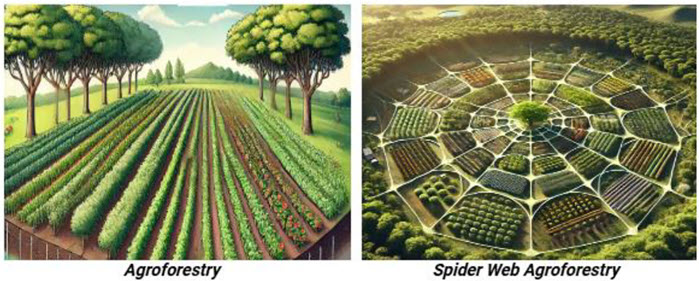
Agroforestry systems are well known to improve soil health, biodiversity, and mitigate climate change by sequestering soil organic carbon (SOC). Nevertheless, the carbon stabilization and permanency over time under multi-species agroforestry designs are yet to be fully explored. This article presents a bio-inspired spider-web agroforestry design, conceptualized on the basis of radial and spiral geometry of the spider web, to optimize the space, species interactions, and stabilization of carbon in soil. The framework combines various trees and crops in triangular and radially attached forms to further mixed litter inputs, constant rhizodeposition, and improved soil aggregation. To assess its carbon sequestration capability, we integrate empirical data on long-term agroforestry research with a RothC-based soil carbon dynamics modeling framework. The current strategy contrasts with other standard RothC applications, which are designed to be used with systems that are uniform in nature, since a simplified active-slow passive pool structure and parameterization specific to the design is used to model the biologically complex processes that typify spider-web agroforestry. Carbon loadings, decay process, and inter-pool transfer processes were modeled over 20 years with the same climatic and initial SOC conditions in a traditional agroforestry baseline and spider-web setup. The uncertainty in carbon inputs and turnover parameters was taken into consideration in the Monte Carlo simulations carried out in Python. According to model projections, spider-web design will outperform conventional agroforestry in terms of SOC stocks, which are due to better stabilization of slow and passive carbon pools as compared to temporary accumulation of carbon on the surface. The increased potential of spider-web configuration as the best sequestration device can be further supported by statistical analyses and comparative projections. The proposed design is not a fully calibrated biophysical model; it gives a reproducible framework of the relationship between agroforestry spatial design and long-term soil carbon dynamics.
Masterarbeit
février 2026
Memorial University of Newfoundland
Onyenwe, Chinenye Lynda
This thesis explores approaches to make food systems more sustainable in North America and Newfoundland and Labrador (NL) using regenerative and permaculture methods, by addressing the growing challenges of soil degradation, climate variability, and dependence on imported food. It includes two main parts: a scoping review of 84 articles (from 1994 to 2024) on permaculture’s contribution to food security in North America and a qualitative study based on twenty semi-structured interviews with farmers, NGOs, and government officials in NL. The scoping review identifies six main themes: soil health and land management, water management, biodiversity, animal integration, energy and built systems, and community and economy, revealing widespread ecological and social benefits but persistent policy and market barriers. The qualitative study identifies how farmers in NL adopt regenerative practices like composting, livestock integration, cover cropping, and biochar application, but is constrained by the Crownland policy, environmental degradation, policy misalignment and limited institutional support. These studies show that practices focused on circular use and regeneration can improve ecological resilience, enable communities, and support local food systems. This connects ideas from the circular economy, agroecology, and political ecology. The thesis suggests practical ways to create policies that fit local needs and promote fairer, more sustainable food systems in NL and beyond.
Artikel
janvier 2026
International Journal of Research in Agronomy 2026; SP-9(2): 131-137
Anuradha Ojha, Sourabh Sherawat, Shekar Kaluvala, Swapnajit Chowdhury, Stella D Souza, Subadas Singh, Raushan Kumar, Pramod Kumar and Narendra Chouhan
For the long-term health of the ecosystem and agricultural output, it is very important to manage soil in a way that is sustainable. As the world’s demand for food grows and soils get worse, strategies including low or no tillage, cover cropping, crop rotation, organic additions, and agroforestry have become quite popular. The goal of these methods is to add organic matter to the soil, make it stronger, and stop erosion. This article talks about the history of soil science and some of the most important people who helped it grow. Then it looks at the most important current ways of managing soil and how they affect the health of the soil and the amount of crops that grow. Several regional case studies demonstrate that the adoption of these practices specifically in sub-Saharan Africa, India, and North America has resulted in quantifiable enhancements in production. Data tables show standard procedures, how crops respond, and soil indicators. In general, integrated techniques that use more than one method tend to give the best results in terms of yield and soil fertility. When done correctly, sustainable soil management may increase agricultural yields by different amounts (sometimes tens of percent), make crops more resistant to changes in the weather, and lessen the need for chemicals from outside sources.
Buchkapitel
janvier 2026
Immo Fiebrig, Alfréd Szilágyi, Svenja Lohrer, Mai Abbas
In this chapter, we present individual cases of sustainable (regenerative) farming with the intention to inspire and give food for reflection for local action. We consciously avoid a narrative of ‘feed the world’ imperatives and ‘faster expansion’ within the concept of an ‘ever growing population’ (e.g. Fróna et al., 2019). We intend to showcase what systems farmers have developed to lead ‘a good life’ and to get up every morning, motivated to face the ecological challenges and economic adversities of farming, far away from the business models of corporations linked up to financial markets and their ‘commodification’ of food (e.g. Rundgren, 2015). This chapter is also driven by the admonition to shun the use of biocidal contaminants from agriculture – and by that – from our food. These comprise synthetic pesticides (and antibiotics), including genetically modified (GM) seeds as part of the intellectual property-protected ‘corporate package’. Pesticides are believed by some scientists to create long-term risks to food safety and security and increase the risk of diseases with a long latency period to clinical manifestation. Ailments believed to be caused by pesticides on pandemic scales, such as some cancers or neurologic diseases, must not be a ‘collateral damage accepted with approval’ (e.g. Dorsey et al., 2020; Leu and Shiva, 2018; Pfrimer and Barbosa Júnior, 2017).
Artikel
décembre 2025
BFH-HAFL
Selina Lucarelli
Diese Arbeit untersuchte, wie es in der Schweiz aktuell um Bildungs- und Beratungsangebote zur Permakultur-Landwirtschaft steht – und was es braucht, damit mehr Landwirtschaftsbetriebe permakulturelle Ansätze mithilfe von verbesserten Bildungs- und Beratungszugänge umsetzen können. Grundlage sind leitfadengestützte Interviews mit 22 Akteur:innen unter anderem von Permakultur-Landwirtschaftsbetrieben, Kantonale Bildungs- und Beratungszentren, weitere Beratungsstellen, Verein Permakultur-Landwirtschaft, Hochschulen und Permakulturberatung sowie Akteur:innen vom Bildungsplan Landwirtschaft. Ergänzend wurden schriftliche Umfragen an die gleichen Akteur:innen geschickt.
Die Befragungen zeigten: Von Beratenden wird praxisnahes Fachwissen erwartet – Permakultur-Know-how plus landwirtschaftliche und betriebswirtschaftliche Erfahrung sowie Offenheit über die eigenen Kompetenzen und ihre Grenzen. Permakulturberater:innen mit genügend landwirtschaftlichem Praxiswissen sind bei den Befragten kaum bekannt.
Die Nachfrage nach Bildungsangeboten ist gemischt: Einzelne Kurse (z.B. INFORAMA) sind gut besucht, vor allem von kleineren Betrieben und Privatpersonen; klassische Landwirtschaftsbetriebe bleiben zurückhaltend.
In der formalen Bildung (EFZ, Höhere Berufsbildung) ist Permakultur kaum explizit verankert, doch agrarökologische Inhalte wurden laut Oda AgriAliForm in den neuen Bildungsplänen EFZ gestärkt. Landwirt:innen eignen sich Wissen vor allem über Selbststudium, Beispielbetriebe und Kurse an. Für Berater:innen wird der Wissenszugang teils als ausreichend (Kompetenzplattform, Permakultuemodul HAFL, Netzwerke), teils als lückenhaft wahrgenommen.
Gewünscht werden vor allem praxisnahe Formate mit Hofbegehungen, ehrlichen Einblicken und konkreten Planungs- und Vermarktungsfragen.
Die daraus resultierenden Entwicklungsvorschlägen bündeln sich wie folgt:
– Permakultur schrittweise in EFZ und Höhere Berufsbildung einführen
– Beratung und Prozessbegleitung stärken (Ausbildungen, Peer-to-Peer)
– Netzwerke und Plattformen ausbauen (Arbeitskreise, Hofentwicklungsgespräche, Kooperation mit verwandten Ansätzen)
– Finanzierung und Leuchtturmbetriebe sichern, um funktionierende Beispiele sichtbar zu machen
Dieser Bericht ist eine Kurzfassung der ursprünglichen Arbeit. Insbesondere die Kapitel Material und Methoden sowie Ergebnisse aus Interview und schriftliche Umfrage wurden aus Gründen der Lesbarkeit auf die zentralen Inhalte gekürzt.
Artikel
décembre 2025
Journal of Insect Conservation (2026) 30:7
Agroscope, ETH
Simone Emanuele Schmid, Giotto Roberti, Jaromir Kunzelmann, Sonja Kay & Noëlle Klein
Biodiversity, particularly insects, faces considerable threats in intensively managed agricultural landscapes. Agroforestry systems (AFS), which integrate woody elements into agricultural land, can enhance biodiversity. This study aims to identify management factors influencing orthopteran richness and abundance in AFS. Additionally, it evaluates the utility of passive acoustic monitoring (PAM) for orthopteran detection by comparing it to field monitoring. Orthopteran monitoring was conducted at 20 silvoarable AFS in western Switzerland. Orthopteran richness was recorded using transects and PAM, while abundance was obtained only from transects. Both methods yielded similar species numbers. Daytime PAM detected cryptic or low-abundance species missed by daytime transects but failed to record one non-stridulating and some nocturnal species. Consequently, data from both methods were combined to provide a more comprehensive analysis of factors influencing orthopteran richness. The analysis revealed that increasing plant species diversity within the understory vegetation strips (UVS) had a positive, though not statistically significant, effect on orthopteran species richness. Furthermore, a non-significant reduction trend in orthopteran abundance was observed in conventionally managed agroforestry systems compared to organically managed ones.
Implications for insect conservation Our study shows that PAM can effectively monitor orthopteran richness in AFS. By
increasing plant diversity in UVS and through organic management, farmers can enhance orthopteran richness and abundance
in AFS and support biodiversity conservation.
Masterarbeit
décembre 2025
Universidade de Lisboa
Annika Haag
Urbanisation rapidly transforms natural ecosystems into predominantly surface sealed environments, reducing their provision of vital ecosystem services such as flood mitigation, climate regulation, erosion control and pollution reduction. In this context, urban green spaces such as parks, lawns, and gardens play an important role in maintaining ecosystem functions. Within these spaces, soil health is a key determinant of service provision, with degraded soils exhibiting reduced efficiency. The aim of this study was to evaluate how permaculture-based agroforestry systems influence soil health, soil functionality, and the mitigation of anthropogenic air pollution compared to conventional green space management. Research was conducted in two small-scale permaculture agroforests and two conventional lawns on the campus of the Faculty of Sciences of the University of Lisbon, representing a gradient of structural complexity: a simple lawn, a lawn with trees, and agroforests established in 2016 and 2021, respectively. Soil samples were analysed for key health indicators including soil organic matter (SOM), soil organic carbon (SOC) and bulk density (BD), while soil functionality was assessed via glyphosate degradation potential. Lichen transplants were used as bioindicators for air pollution, measuring photosynthetic performance, heavy metal accumulation and magnetic susceptibility. We hypothesised that (1) soil health indicators improve with structural complexity, (2) soils in more complex systems exhibit greater glyphosate degradation potential and (3) the vertical structure of agroforests reduces air pollution exposure. Results indicate that small-scale urban permaculture agroforests significantly enhance soil health, with higher SOM, reduced BD, and SOC gains of up to 57% relative to conventional management. Glyphosate degradation potential increased with structural complexity, and the vertical vegetation of agroforests acted as an effective barrier to anthropogenic pollutants. These findings highlight the potential of structurally complex green space management to yield relevant ecological benefits both above- and belowground, even when applied at small scales.
Artikel
novembre 2025
Agroscope, ZHAW
Kay, Sonja; Jäger, Mareike; Anspach, Victor; Hirschvogel, Christa
Agroforstsysteme wirken als Kohlenstoffsenken: während ihres Wachstums binden Bäume und Sträucher CO₂ und speichern es in ihrer holzigen Biomasse sowie im Boden. Dadurch wird der Atmosphäre CO₂ entzogen. Solange das Holz nicht verrottet oder verbrannt wird, entfaltet der in der holzigen Biomasse gebundene Kohlenstoff eine Klimawirkung. Es gibt u.a. Systeme mit Wertholz, Obst- oder Nussbäumen und schnellwachsenden Bäumen sowie Hecken wie bspw. Futterhecken. Agroforstsysteme bieten zudem Potenzial zur Klimaanpassung durch die Erhö-hung der Resilienz der Agrarsysteme.
Monitoring: Das Monitoring erfolgt durch die Messung des Durchmessers und der Höhe der Bäume bzw. Hecke und der Berechnung des Holzvolumens. Diese Daten erlauben eine modellbasierte Abschätzung des gespeicher-ten Kohlenstoffs pro Hektare.
Empfehlungen: Da Bäume Zeit zum Wachsen benötigen und ihr volles Senkenpotenzial erst mit zunehmendem Alter entfalten, sollte die Etablierung rasch gefördert werden. Eine Anschubfinanzierung und gezielte Beratungen werden als zentrale Hebel empfohlen, um Anfangsschwierigkeiten bzw. bestehende Hemmnisse zu überwinden. Dann kann Agroforst einen bedeutenden, multifunktionalen Beitrag zur klimaneutralen Landwirtschaft leisten.
Artikel
novembre 2025
Bonfils, Patrick; Herzog Felix
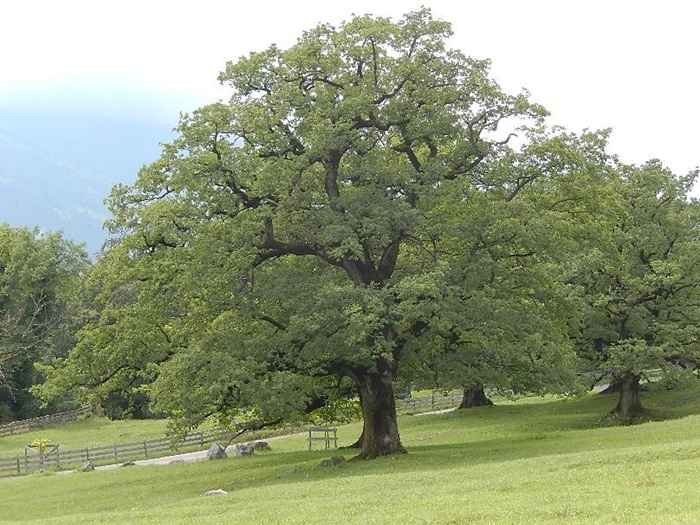
Die Eiche wird nicht nur als Wertholz geschätzt, sondern auch wegen ihrer grossen Bedeutung für die Biodiversität und als Kulturerbe. Die aktive Förderung diese Baumart beschränkt sich heute grösstenteils auf das Waldareal. Mit dem wachsenden Interesse an der agroforstlichen Produktion in der Landwirtschaft erhalten Bäume nun auch hier neue Aufmerksamkeit. Sie speichern CO₂, verbessern Wasserhaushalt und Bodenschutz, fördern Biodiversität, schaffen günstiges Mikroklima, liefern zusätzliche Produkte und erhalten Kulturlandschaften. Damit tragen sie zur ökologischen Resilienz und wirtschaftlichen Basis von Landwirtschaftsbetrieben bei. Der Verein proQuercus will mit diesem Merkblatt die Einsatzmöglichkeit der einheimischen Eichenarten im Agroforst ausloten und das Interesse an dieser faszinierenden Baumart über den Wald hinaus wecken.