Agroforestry systems combine rows of trees, shrubs with arable crops (silvo-arable) and pasture (silvo-pastoral). They offer potential for increased biodiversity, more resilient agriculture, and additional sources of income. Yet their implementation is complex and often costly – how can agroforestry practices be successfully realised in practice?
Different Soils, Similar Challenges
Central Germany features a wide range of soils, from sandy and stony fields to fertile loess and clay soils [1]. Some farms integrate livestock, while others focus solely on crops production [2]. These differences affect water retention, nutrient availability, and soil structure. At the same time, similar challenges arise across all sites: low rainfall, late spring frosts, and compacted soils due to years of intensive cultivation [2].
The key question is: How can agroforestry, using regenerative practices, adapt to diverse soils and climatic challenges to ensure long-term sustainability and productivity?
Farm Tour at Werragut
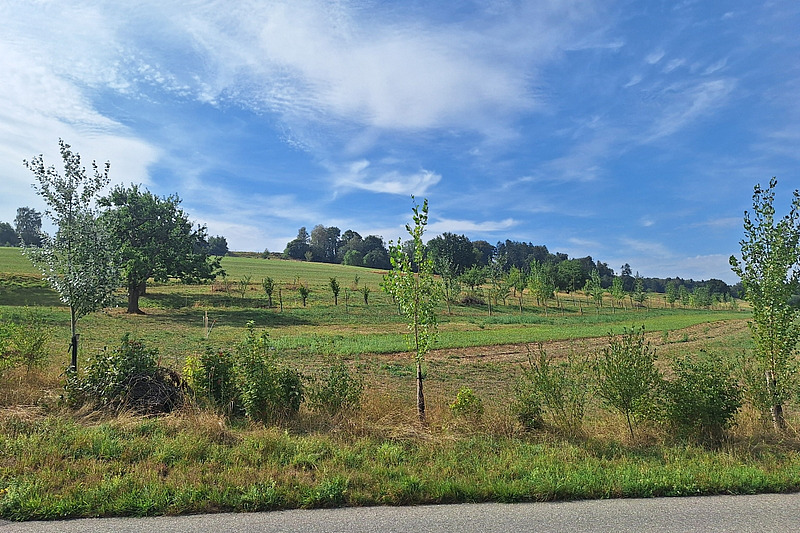
During our visit to Werragut Farm [3] in Eschwege, we explored a diverse 12 hectare agroforestry system. Trees and shrubs are planted along contour lines to optimise water retention and minimise erosion. The system integrates over 1,000 woody plants across more than 15 varieties. Species selection is adapted to future climate conditions and includes fig, mulberry, walnut, hazelnut, cornelian cherry, and sweet chestnut – what the farmers refer to as a “muesli cultivation.” The areas between the rows are used either for growing crops or as pasture.
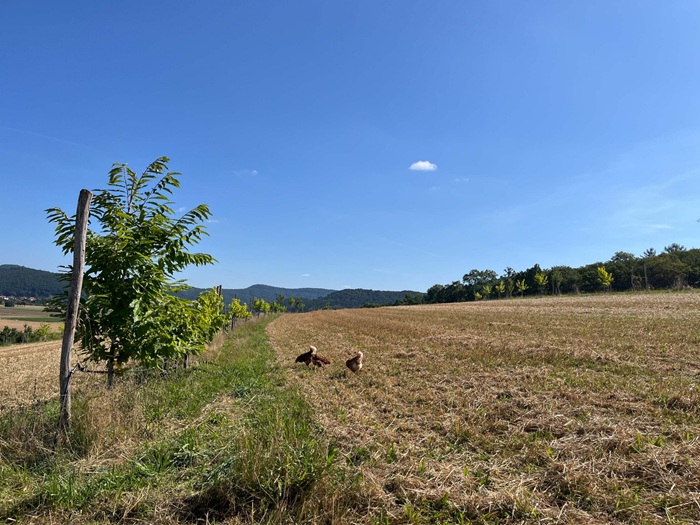
The farmers described the challenges posed by extreme weather: after planting, some trees had to be replaced, and an irrigation system was installed. This system does not feature mixed planting rows. A particularly positive and interesting observation was the chickens, which roamed peacefully between the rows in mobile coops, contributing to pest control and nutrient cycling. Rare cattle breeds “Rotes Höhenvieh” are also integrated.
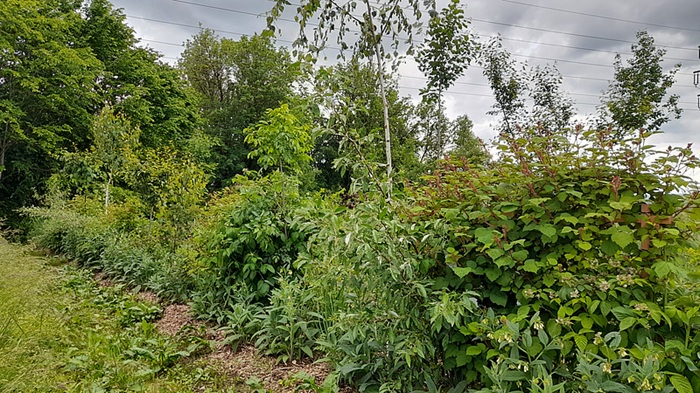
Another small area on the farm demonstrated a highly mixed planting of various species following the principle of “Syntropic Farming” [4]. Here, we were able to taste fresh, juicy raspberries directly from the bush.
Goals and Design: More Than Just Planting
Agroforestry systems aim not only to increase yields – through fruit, nuts, or timber – but also to provide ecological benefits: they improve soil fertility, support insects, protect against extreme weather, and create new income streams [2], [4].
Thoughtful design uses vertical layering and succession, so that trees, shrubs, and crops complement each other. Year-round ground cover, mulching, and targeted plant combinations help retain moisture, support biodiversity, and maintain soil fertility [4].
Mechanisation and Workload
Agroforestry is generally more labour-intensive than monocultures [2], [5]. In the first years, when yields are low, self-harvesting initiatives can help. Later, mobile harvest nets, collection machines, or compact harvesting equipment reduce the workload. Machinery-sharing and collaborations can also lower costs. Crucially, mechanisation must not compromise the ecological benefits of the system. Planning of harvesting equipment and work processes remains a major challenge but is essential for long-term success.
…