A Bio-Inspired Design Framework for Sustainable Land Use and Carbon Sequestration Potential
Publikation
Arun Kumar K., Jayanthi J., Balkrishna S. Bhople
Zusammenfassung
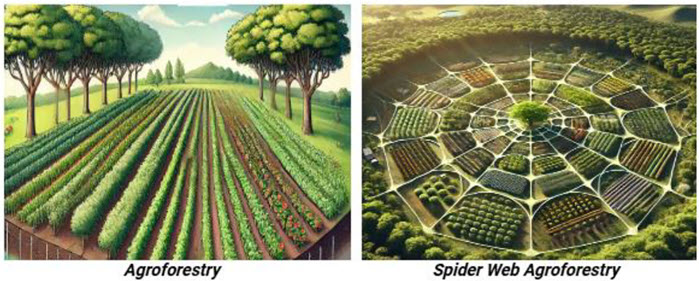
Agroforestry systems are well known to improve soil health, biodiversity, and mitigate climate change by sequestering soil organic carbon (SOC). Nevertheless, the carbon stabilization and permanency over time under multi-species agroforestry designs are yet to be fully explored. This article presents a bio-inspired spider-web agroforestry design, conceptualized on the basis of radial and spiral geometry of the spider web, to optimize the space, species interactions, and stabilization of carbon in soil. The framework combines various trees and crops in triangular and radially attached forms to further mixed litter inputs, constant rhizodeposition, and improved soil aggregation. To assess its carbon sequestration capability, we integrate empirical data on long-term agroforestry research with a RothC-based soil carbon dynamics modeling framework. The current strategy contrasts with other standard RothC applications, which are designed to be used with systems that are uniform in nature, since a simplified active-slow passive pool structure and parameterization specific to the design is used to model the biologically complex processes that typify spider-web agroforestry. Carbon loadings, decay process, and inter-pool transfer processes were modeled over 20 years with the same climatic and initial SOC conditions in a traditional agroforestry baseline and spider-web setup. The uncertainty in carbon inputs and turnover parameters was taken into consideration in the Monte Carlo simulations carried out in Python. According to model projections, spider-web design will outperform conventional agroforestry in terms of SOC stocks, which are due to better stabilization of slow and passive carbon pools as compared to temporary accumulation of carbon on the surface. The increased potential of spider-web configuration as the best sequestration device can be further supported by statistical analyses and comparative projections. The proposed design is not a fully calibrated biophysical model; it gives a reproducible framework of the relationship between agroforestry spatial design and long-term soil carbon dynamics.
Stichworte
bio-inspired system design; carbon sequestration; RothC-derived modeling; soil carbon stabilization; soil organic carbon (SOC); spider-web agroforestry model; sustainable land use
Teile diesen Beitrag