
An incremental optimization methodology for evaluating the potential of photovoltaic and battery energy storage-based energy communities: A hybrid agrivoltaic-agroforestry case study in the Czech Republic

Artikel

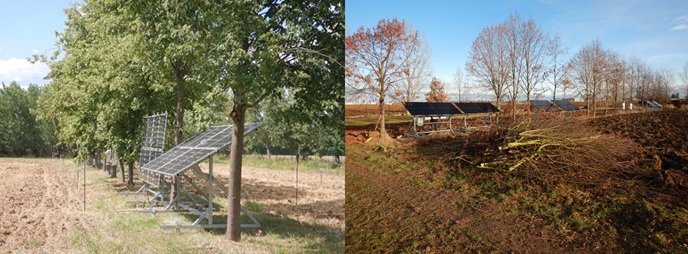
Photovoltaik in Agroforststreifen
Bild: Energy Reports

Publikation
14.03.2026

Autorinnen / Autoren
L. Janota, J. Weger, J. Knápek, K. Vávrová


Landscape Research Institute, Czech Republic

Highlights

  • This study proposes a comprehensive Incremental Capacity Optimization Algorithm Based on NPV Evaluation.
  • A comprehensive technical-economic model of the energy community operation is designed.
  • An experimental hybrid Agroforestry and Agrivoltaics installation was performed.
  • Simulations of diverse CEC member load profiles were conducted.
  • Agrivoltaics and BESS integration in energy communities prove economically viable.
Zusammenfassung

Successful energy transition and climate action require accurately dimensioned local renewable energy systems. This study develops a deterministic techno-economic model and an incremental optimisation methodology to evaluate photovoltaic, agrivoltaic and battery storage technologies within energy communities. A 100-member community is simulated using hourly load profiles and both PVGIS-based and real agrivoltaic–agroforestry generation data. Under the NPV=MAX criterion, battery storage is not economically viable and photovoltaic installations reach 17–26% energy self-sufficiency. Under the NPV= 0 criterion, optimal agrivoltaic capacity increases by 60–100%, battery storage becomes deployable, and self-sufficiency rises to 27–45%. Avoided GHG emissions increase from 73.6 tCO₂/year under the NPV-maximisation objective to 122.7 tCO₂/year under the NPV = 0 (break-even) configuration in the simulated 100-member community, clearly demonstrating the environmental benefit of self-sufficiency-oriented sizing. The strong divergence between both optimisation objectives demonstrates that investment intent fundamentally shapes the technical, economic and environmental outcomes of community energy systems. These findings underscore the need for robust pre-project sizing tools to design effective, resilient and low-carbon local energy solutions.

Mots-clés

Energy community, Capacity optimization algorithm, Agrivoltaics, Energy self-sufficiency, Renewable energy integration

Partager cet article

Weitere Publikationen

Vous avez des questions sur l'agriculture permaculturelle ?

Contactez-nous

Défiler vers le haut