Results from the National Agroforestry Producer Survey
Publikation
Matthew M. Smith, Kristin Floress, Todd Kellerman, Gary Bentrup, Katherine MacFarland, Mark Batcheler & Lord Ameyaw
Springer
Zusammenfassung
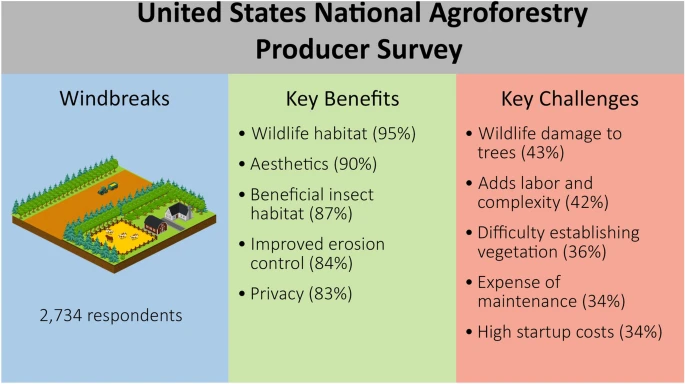
Windbreaks are an agroforestry practice that have been used extensively in the United States for centuries. Researchers have investigated why producers use windbreaks through regional surveys; however, no national analysis has been conducted on windbreak extent or adoption, limiting understanding of key information needed to guide technical assistance and research. To address this knowledge gap, the National Agroforestry Producer Survey was conducted. The survey was completed by 5682 producers with agroforestry (52% response rate). This study provides results from the 2734 producers who reported using windbreaks, one of the five agroforestry practices covered in the survey. Windbreak use spanned all farm size classes and regions. Windbreak acreage per farm averaged 10.2 acres (4.1 hectares) equivalent to roughly 3.8% of land area per farm with the practice. Producers reported using farmstead (60%), livestock (48%), boundary (47%), and field windbreaks (43%), along with hedgerows (40%) and living snow fences (13%). Key benefits for each windbreak type differed and corresponded to the primary function for which that windbreak type was designed. Across windbreak types, the most frequently cited challenge was wildlife damage to trees. Over 85% of producers also reported harvesting crops and products from their windbreaks, with 33% selling crops and products from windbreak vegetation, and 79% using crops and products for personal or on-farm use. Most operations established windbreaks at least 15 years prior to the survey, and 87% of producers reported a desire to maintain or expand the acres they have in windbreaks.
Stichworte
Windbreak, Shelterbelt, Hedgerow, Agroforestry, Survey, Conservation practice
Teile diesen Beitrag