
Use of willow (Salix sp) biomass as tree fodder: nutritional value and conservation methods
Artikel
Publikation
Sonia Pereira-Crespo, Pilar Gago, Adrián Botana, Marcos Veiga, Juan Castro, Laura González, María del Pilar Martínez-Diz, César Resch, Dalia A. Plata-Reyes, Roberto Lorenzana & Gonzalo Flores-Calvete
Springer
Zusammenfassung
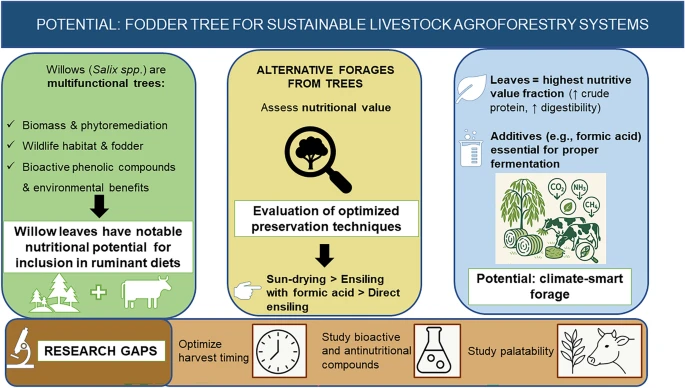
This study evaluated the nutritional value and different methods of conservation of two willow materials—the hybrid clone Terra Nova (HTN) from a short‑rotation coppice (SRC) system and the native Salix atrocinerea (SAT) from riparian stand—representing contrasting willow resources available in the study region. The leaf fraction (LE)—although representing < 50% of total stem biomass—, showed the highest nutritional value versus stems, leaf crude protein (CP) reached 23.7% dry matter (DM) in HTN and 17.7% DM in SAT, with in vitro organic matter digestibility (IVDMO) 52.75% in HTN and 38.8% in SAT; by contrast, edible stems showed much lower CP (3.3–5.8% DM) and IVDMO (11.8–31.2%). Leaf Relative Forage Value (RFV) was “Good” in HTN (110–115) and “Poor–Fair” in SAT (82). Sun‑drying proved most effective at preserving nutritional quality, followed by formic acid‑assisted ensiling. Both materials showed poor suitability for ensiling because of low water‑soluble carbohydrate levels, requiring additive application to reach target pH (4.5 vs. > 5.0 in untreated silages). Willow leaf silages achieved CP levels of 18–22% DM (up to 27.8% in HTN with additive), while fermentation intensity remained low; SAT leaves showed a higher fermentability coefficient (44 vs. 28), consistent with better acidification. The HTN material proved suitable as a protein supplement for moderate‑energy diets, whereas SAT was limited to maintenance‑level feeding. Willow forage shows notable potential as a supplemental fodder resource for ruminant systems, although effective preservation requires additive use to maintain nutritional quality during storage.
Stichworte
Agroforestry, Salix atrocinerea, Ruminant nutrition, Silage quality, Short-rotation coppicing, Willow leaves
Teile diesen Beitrag