
Schweizer Agroforstsysteme erfüllen die Erwartungen der Landwirtschaft und tragen zum Klimaschutz bei

Artikel

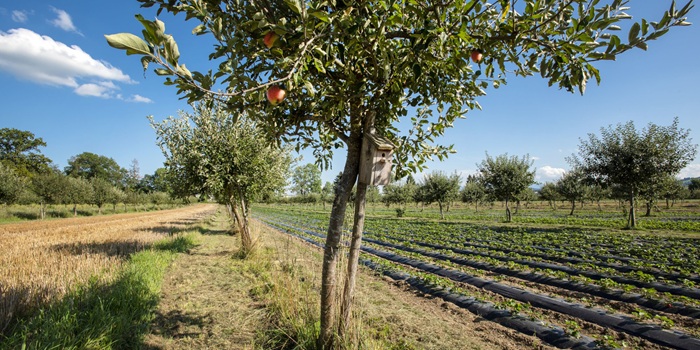
Schweizer Agroforstsystem
Bild: Gabriela Brändle, Agroscope

Publikation
16.07.2025

Autorinnen / Autoren
Roberti G., Herzog F., Jäger M., Kay S.


Agroscope, ZHAW

Originaltitel: Temperate agroforestry for tree carbon storage in Switzerland: 10 years of biophysical and social monitoring

An vier Agroforstsystemen haben Wissenschaftlerinnen und Wissenschaftler über zehn Jahre das Baumwachstum gemessen und daraus die Kohlenstoffspeicherung berechnet. Die Daten helfen, Agroforstsysteme besser zu verstehen, sie zu planen, sie umzusetzen und ihre Klimaschutzwirkung zu evaluieren.

Fazit

  • Das Baumwachstum und das CO₂-Speicherpotenzial der Bäume schwankte in den vier untersuchten Agroforstsystemen und lag zwischen 0,4 und 2,5 Tonnen CO₂-Äquivalenten pro Hektar und Jahr.
  • Berechnungsmodelle, die Baumart und Standort berücksichtigen, können bei der Planung und Umsetzung von Agroforstsystemen unterstützen.
  • Die vier beobachteten Betriebe haben ganz unterschiedliche Systeme umgesetzt, um ihre jeweiligen Ziele zu erreichen. Sie haben realistisch geplant und sind bisher mit der Zielerreichung weitgehend zufrieden.
Zusammenfassung

Agroforestry, the integration of woody structures in agricultural land, has high potential for climate protection and resilience, since trees are active carbon sinks. Yet, there is only limited empirical evidence on the actual performance of temperate agroforestry systems in this respect, nor on its acceptance by farmers. We monitored four silvoarable agroforestry systems in Switzerland (apple, sour cherry, poplar, wild cherry) over ten years and measured tree growth and carbon storage performances. We compared the measured data to outcomes of the Yield-SAFE model. We regularly interviewed farmers on their observations of their agroforestry systems. Individual growth of agroforestry trees varied between species and location, with differences between the smallest and largest tree ranging from 44 % to 97 %. Consequently, the carbon sequestration potential varied substantially between 0.4 and 2.5 t CO2eq per year and hectare. The modelling approach showed a good fit for apples and wild cherries and – after (re)calibration with local data – also for poplars and sour cherries. Tree mortality was up to 20 % in the first years but if replaced, this did not influence the overall outcome after ten years. Farmers‘ evaluations differed, depending on the motivation of individual farmers. They changed only slightly with time, indicating that their expectations had been realistic. The study highlights the usefulness of long-term empirical data for model calibration and of monitoring farmers‘ satisfaction. Realistic model predictions and management of farmers‘ expectations will facilitate the implementation of agroforestry.

Stichworte

Carbon sequestration, Farmer interview, Intercropping, Modelling, Silvoarable systems, Yield-SAFE

Teile diesen Beitrag

Weitere Publikationen

Publikation

Haben Sie Fragen zu Permakultur-Landwirtschaft?

Kontaktieren Sie uns

Nach oben scrollen